

Damaged skin barrier: how to recognize it


Posted: · Updated:
You can recognise a damaged skin barrier by skin that keeps feeling tight and dry, even shortly after applying cream. Products you've always used suddenly start to sting or burn, your skin turns redder for no clear reason and sometimes you get more spots. The cause is often a routine with too many or too strong products, such as acids, retinol or harsh cleansers.
Do you know that feeling? Your skin feels tight. Sensitive. Maybe even a bit burning. Products you've always used suddenly sting. And whatever you try, it only seems to get worse. Sound familiar?
Then there's a good chance your skin barrier is damaged. You're not alone: it's one of the most common skin complaints, and yet many people don't know exactly what's going on. In this blog we help you recognise the signs and understand the causes, so you know where you stand.
How do you recognise a damaged skin barrier?
A damaged skin barrier shows itself in different ways. Sometimes it's one symptom, sometimes a combination. Below we describe the most common signs.
1. Your skin feels tight and dry
One of the first things you notice: your skin feels tight. Especially after cleansing, but sometimes simply throughout the day. It seems as if your skin is constantly short of moisture, no matter how thickly you apply your cream. And that's right. When your skin barrier is damaged, your skin is less able to retain moisture. It simply evaporates faster than normal. The protective layer that keeps moisture in the skin is disrupted or porous.
2. Your skin quickly reacts sensitively
Products you've always used without any problems suddenly cause irritation. Your skin feels oversensitive: as if everything is too much, but also as if it's lacking all sorts of things. Even water can sometimes sting. This is a clear sign that your skin's protective layer has weakened and is less able to keep out irritants.
3. Redness and irritation
You see red patches or an overall reddish glow more often, especially on the cheeks, around the nose or on the forehead. This redness can last all day or come and go. It's your skin's reaction to influences that would normally not be a problem.
4. A burning or tingling feeling
This goes beyond sensitivity: your skin burns or stings, especially when you apply a product. Sometimes even with products made specifically for sensitive skin. That burning feeling is a sign that the outer layer of your skin is not providing enough protection.
5. Blemishes increase
It may sound contradictory, but a damaged skin barrier can also lead to more blemishes. Because your skin's balance is disrupted, overproduction of sebum can occur. Your skin tries to compensate, resulting in spots or blackheads.
Not sure whether your skin barrier is damaged? These are the signs
Do you recognise yourself in one or more of these points? Then your skin barrier is probably out of balance:
- Your skin feels tight and dry, even shortly after applying cream
- Products you've always used suddenly sting or burn
- Your skin is redder than usual, for no clear reason
- You have blemishes or spots more often
- Your skin feels rough or flaky
- Nothing seems to help, whatever you try
Do you recognise several of these signs? Then your skin barrier is probably out of balance. The good news: with the right approach, your skin can recover. Curious how you can restore your skin barrier with ingredients of 100% natural origin?
Sensitive skin or damaged skin barrier: what's the difference?
Sensitive skin and a damaged skin barrier are similar, but they're not the same. Sensitive skin has often been that way for years. You know which products you'd better avoid and your skin always reacts to the same things. With a damaged skin barrier, something changes: products you've always used without problems suddenly cause irritation. That indicates the protective layer is temporarily working less well. Do the complaints persist after a few weeks? Then ask your GP or a skin therapist for advice.
What happens when your skin barrier is damaged?
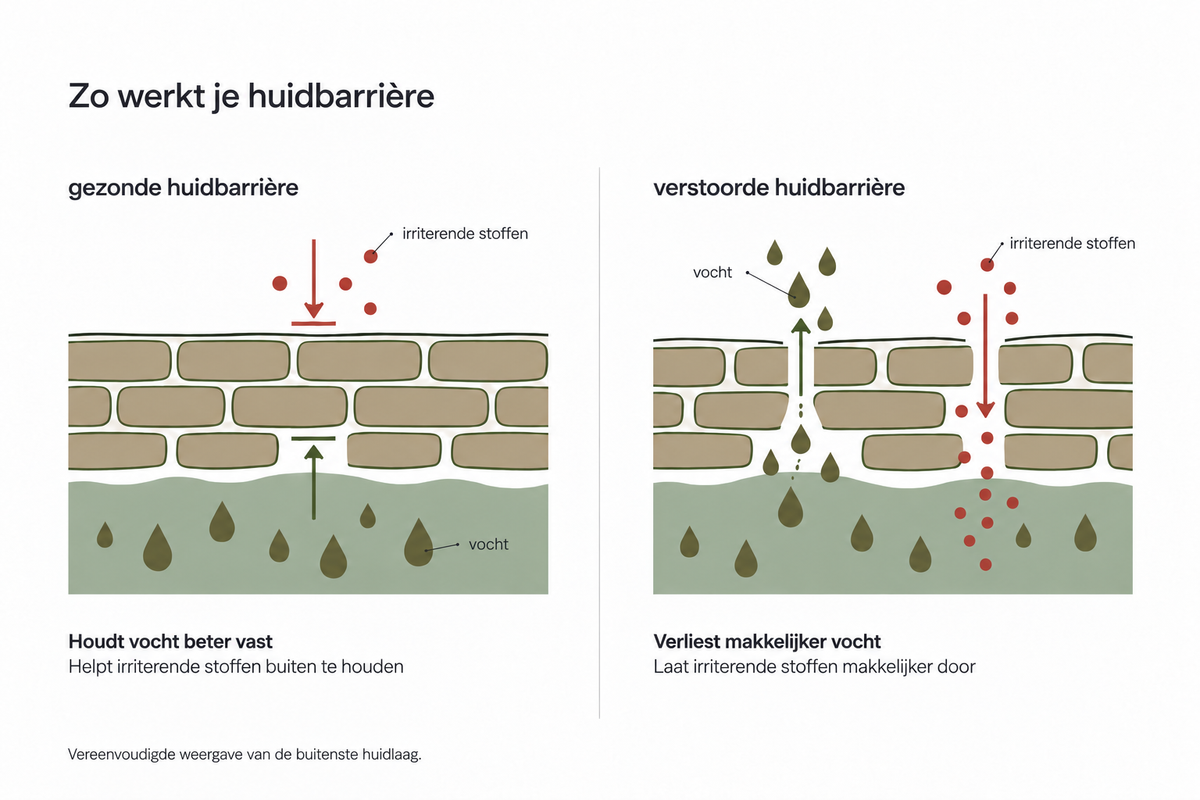
Your skin barrier is the outer protective layer of your skin. You can compare it to a little wall of skin cells held together by fats and lipids. When that wall gets damaged, small cracks appear, as it were.
Through those cracks, moisture evaporates from your skin faster, causing dryness. At the same time, irritants, bacteria and other external influences can get in more easily. The result: your skin becomes more sensitive, reacts faster, and recovers more slowly.
Causes of a disrupted skin barrier
There are various reasons why your skin barrier can become damaged. Sometimes there's one clear cause, but more often it's a combination of factors. And honestly? You might be doing some things without even knowing it.
1. Skincare that is too harsh
Products with a lot of alcohol, fragrance or strong active ingredients can do your skin more harm than good. They strip the natural oils from your skin, making the protective layer thinner. Especially if you combine several of these products, it can quickly become too much.
2. Cleansing or exfoliating too often
Cleansing your face twice a day sounds hygienic, but with the wrong product or a cleanser that's too harsh, you do more damage than you think. The same goes for scrubs or chemical exfoliants: once or twice a week can be nice, but daily is too much for most skin types.
3. Active ingredients (acids, retinol)
Acids such as AHA, BHA and retinol are popular, and not without reason. But these active ingredients are powerful. Concentrations that are too high, using them too often, or combining several actives can overload the skin barrier. Especially if your skin hasn't been built up to them slowly.
4. Weather, cold and air pollution
External factors also play a role. Cold air in winter dries out your skin, while wind and air pollution affect the outer skin layer. Changing temperatures - from outside to a heated room - make it extra difficult for your skin to stay in balance.
5. Stress and lifestyle
It may sound like a cliché, but stress really does affect your skin. Chronic stress raises the cortisol level in your body, which can weaken the skin barrier. Lack of sleep, medication, an unbalanced diet, too much alcohol and drinking too little water also contribute to a disrupted skin barrier.
What should you do if your skin barrier is damaged?
Do you recognise several signs of a disrupted skin barrier? Then go back to basics. Less is more. Choose gentle cleansing, hydrating care and give your skin rest. Avoid products that sting or irritate for the time being and don't keep trying something new.
With a simple routine you give your skin room to calm down. How to approach this step by step, you can read in our step-by-step plan to restore your skin barrier.
Back to basics


What should you not do with damaged skin?
Just as important as what you do, is what you'd better not do. We understand this is difficult, because you feel you need to do more, but give your skin at least two weeks of rest (sometimes your skin still feels unsettled during the first few days) and observe what this does to your skin.
These are the most common mistakes:
- Continuing to exfoliate. If your skin barrier is already damaged, scrubbing or using acids is the last thing you want to do. You literally remove more of that protective layer.
- Combining too many products. It's tempting to try all sorts of things, but every extra step in your routine is an extra potential irritant. Keep it simple.
- Constantly changing your routine. Your skin needs time to recover. If you try something different every week, you never give your skin the chance to adjust and recover. Choose a simple routine and give it at least a few weeks.
“Choose a simple routine and give it at least a few weeks.”
How long does it take for damaged skin to recover?
That depends on how severe the damage is and how you deal with it. With a calm routine, you often see a difference after 3 to 4 weeks. Consistency is really key! How to approach it, you can read in how to restore your skin barrier.


