
What does stress do to your skin?
Stress. Everyone experiences it at some point. It’s a rushed feeling that can sometimes completely throw you off balance. Think of a missed deadline, a busy period, or worries about someone else. Stress is different for everyone: some people are more affected by it than others.
When you're stressed, your body reacts. Your heart beats faster, and you might start sweating. But did you know that stress also affects your skin? Your body and skin are strongly connected; after all, your skin is your largest living organ. So, if you're not feeling well, it will likely show on your skin. A stressful period is therefore the perfect time to take extra care of yourself and your skin.
How stress hormones affect your skin
When you're stressed, your body produces the hormone cortisol. A short period with cortisol is normal. It helps your body to react quickly, for example, in case of danger, also known as the 'fight-or-flight response'.
During prolonged stress, cortisol levels remain too high. You’ll notice this through fatigue, poor sleep, or an increased craving for sweet and fatty foods. But stress also affects your skin. Cortisol causes your skin to produce more sebum to protect itself. This can make your skin oilier and more prone to pimples due to clogged pores. The skin barrier also weakens. The natural microbiome on the skin is disrupted, causing your skin to retain less moisture and become more easily irritated or inflamed.
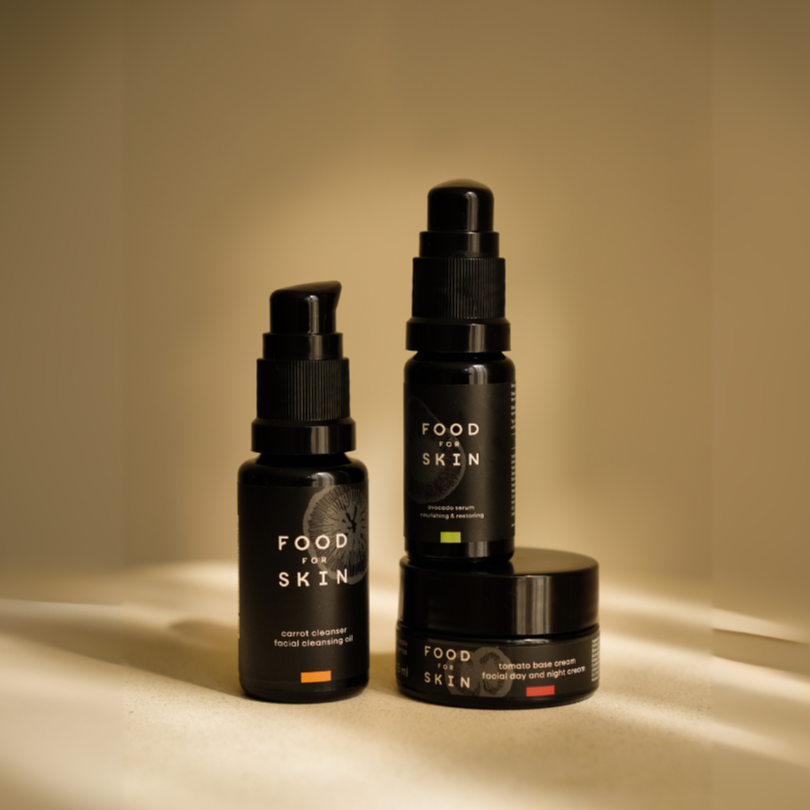
At Food for Skin, we therefore consider a strong skin barrier very important, especially during stressful times. With our products, you can build a good basic routine that supports your skin and keeps its microbiome balanced. The Carrot Cleanser, Cucumber Serum, and Tomato Base Cream together form an excellent foundation. Give your skin time to recover. If you care for your skin gently and regularly, you often see improvement within 3 to 4 weeks, as your skin will have completed a full skin cycle by then, and you can start to see results. Want to know more about this? Read our blog about the skin barrier.
Common skin reactions to stress
Pimples and impurities
As mentioned earlier, stress hormones like cortisol cause the skin to produce more sebum. This can lead to pores clogging more easily and the appearance of stress pimples. Many people notice that during busy periods (a deadline, an exam week, or family situations), they suddenly get more impurities around the chin and jawline. This is because stress exacerbates inflammatory reactions.
Tip against pimples and impurities: What helps is drinking plenty of water and low-tannin tea, and keeping your routine simple. Your skin is often already a bit oilier, so minimizing the layering of products is important. Gentle cleansing is the foundation and most important. The Carrot Cleanser cleanses and nourishes simultaneously. Jojoba Oil applies a protective layer to the skin to prevent dryness, and carrot extract aids skin recovery through vitamin A.
Redness, spots, or hives
When you're stressed, your body can produce small amounts of histamine. Histamine is related to your immune system. This can cause your skin to suddenly turn red, develop spots, or become itchy. Sometimes, hives even appear. These skin reactions often occur on the neck, chest, or cheeks. The skin can feel warm, itchy, or prickly – an unpleasant sensation!
Tip to prevent redness, spots, or hives: It is especially important to allow yourself calming moments. This can be achieved through controlled breathing, meditation, or fragrance-free oils.
Dry, sensitive skin
During prolonged stress, your skin produces fewer lipids, such as ceramides and fats. These substances are crucial for a strong, resilient skin barrier. When the skin barrier weakens, your skin loses moisture more quickly, as literal gaps form in your skin. Your skin can then become more sensitive to cold and heat, skincare products, and even tap water. You may experience flakiness, a tight feeling, or a burning sensation on the skin.
Tip for dry and sensitive skin: keep your routine small and simple. Avoid foaming soap cleansers and exfoliate a maximum of 1–2 times a week if your skin tolerates it. Choose ingredients that help repair the skin, such as shea butter, a mild ingredient found in our Apricot Bar.
Worsening of existing skin conditions
Stress can worsen skin problems like rosacea or eczema. The skin then reacts more quickly to heat, certain foods, synthetic ingredients in cosmetics, or strong emotions. Many people notice their cheeks getting redder or eczema flaring up when they are under a lot of tension. This is very frustrating and difficult to resolve.
Tip for worsening existing skin problems: focus on calming and protecting the skin. Use fragrance-free products, wash your skin with lukewarm water, and apply a nourishing cream as needed to prevent moisture loss, such as the Tomato Base Cream.
Accelerated aging / loss of glow
During prolonged stress, harmful substances remain more active in the skin. These substances can cause the skin to age faster than normal. The skin may look duller, feel less supple, and develop fine lines more quickly.
Fortunately, the skin is a super mechanism that can repair itself when there is more rest. Sufficient sleep, less stress, and a simple skincare routine help with this. Products with antioxidants, such as vitamin C or green tea, support recovery. This way, you'll feel like yourself again quickly!
How to recognize stressed skin?
Stress in your body is quickly noticeable by how you feel. But how do you actually notice this on your skin? Stressed skin often has a dull complexion, more pimples than usual (especially on the chin, jawline, and forehead), or manifests through rashes and itching on the neck, chest, or cheeks.
So, do you have
- Red spots around the neck
- Suddenly a lot of pimples (on the chin, jawline, forehead)
- A dull complexion on the skin
- Itchy skin in combination with redness
... then it could be due to stress. These are very normal reactions and a signal to take extra care of yourself (and your skin).
It helps to keep a close eye on your skin if you see changes, so you can better understand what your skin is trying to tell you it needs. Listen to your skin!
What can you do to calm stressed skin?
Practical stress reduction for your skin
Your skin reacts to what's happening in your mind. Simple daily habits can make a big difference. Breathing is a powerful tool: inhaling for 4 seconds, exhaling for 6 seconds already helps to calm your nervous system. Walking outdoors, relaxation exercises like yoga, or consciously taking a break also lowers cortisol levels. Accept that you're not feeling great for a while, and allow yourself a moment of rest.
Keep your skincare simple and skin-friendly
A simple skincare routine is more than enough to keep your skin happy. You can achieve this with skincare that is nourishing and caring. Make sure you use a mild cleanser that cares for the skin and helps restore the skin barrier. Treat yourself to fifteen minutes of sun on a beautiful day! Most people produce enough vitamin D if they spend 15 to 30 minutes with their face and neck unprotected in the sun during spring and summer (KWF, 2025). If you spend more time in the sun or are very sensitive? Then use an SPF factor 30, as UV light can cause extra stress and inflammatory reactions from this point on.
Create an easy and effective skincare routine for yourself. With our trial sets, you can experience for yourself how easy and effective such a self-care moment can be.
Protection against additional stressors
Stressed skin can tolerate less and becomes overloaded more easily. Therefore, it is wise to actively avoid triggers. As we mentioned earlier, fifteen minutes unprotected (maximum! For very fair skin, this can be as little as 5 minutes in summer) in the sun is very important for vitamin D production. Make sure you use a good SPF of at least factor 30 after 15 minutes, as UV after this point can cause inflammatory reactions, collagen breakdown, and redness.
Also avoid aggressive cosmetics such as products with synthetic perfumes or non-fatty alcohols. Over-treatment (too many products, retinol, or treatments at once) can also further damage the skin barrier. Opt instead for gentle, restorative products with natural, nourishing ingredients. Fewer products with better-performing ingredients lead to happier skin, as the skin is very capable of repairing itself!
Lifestyle makes a visible difference
Your lifestyle has a significant impact on your skin. This starts with a good night's sleep. Sufficient sleep helps to balance the stress hormone cortisol and gives your skin time to recover.
A walk outside does you good in times of stress; for example, during fifteen minutes of unprotected sun exposure, you can produce vitamin D, which is good for the immune system. Longer than fifteen minutes in the sun? Make sure you apply SPF 30 to protect your skin.
It is also important to drink enough water throughout the day. This helps to hydrate your skin from within. In addition, healthy eating plays a major role. Eat a varied diet and often choose vegetables, healthy fats, and foods with antioxidants. These help reduce inflammation in the body. Want to know more about nutrition and its impact on your skin? Read it here.
Small, daily habits collectively make a big difference. They help you feel fitter and better in your skin, all day long!
Want to give your skin a fresh start? Our trial sets help restore your skin barrier.
Conclusion: how to tackle stress-related skin problems
You can often tell by your body if you need to adjust something in your daily life. If you're not feeling well, it's highly likely to show on your skin. But no reason to panic, your skin recovers faster than you think! Don't immediately start using all sorts of other harsh skincare products. This is often a moment to pause and adjust something in your daily routine. Our advice is to be extra kind to yourself during such moments. Take good care of your body and skin, and your body will do the rest. Be kind to yourself and occasionally allow yourself the rest you need.