Tips against dry skin in winter
2023-05-19 cathy molenaar
It's getting colder again. Lights in the garden, early darkness, and maybe even snow... but also a cold or a runny nose is part of it. Besides your body, your skin also needs to get used to the change. Flaky skin, itchy skin, pimples, a worsening of eczema or rosacea... Your skin really needs a little more attention during such a period. That's why here are some tips to get through the winter beautifully.
A dry face in winter
Your skin barrier can be damaged by the friction of cold air. As a result, your skin absorbs nourishing ingredients less effectively, making it drier and more sensitive. This dehydration, in turn, accelerates the skin aging process. The use of scarves and high collars also leads to increased bacterial activity on the skin. Your skin's metabolism is also different in winter. In winter, your sebaceous glands are less active, causing the oily protective layer to diminish. Therefore, extra care for your skin is not a luxury.
What to do about dry skin?
Prevent dry and chapped skin in winter with these tips.
1. Don't shower too hot
Don't shower too hot. You might get red broken veins from this, as your blood vessels expand.
2. Don't lick your lips, but drink plenty of water.
For dry lips: don't lick your lips. Oddly enough, moisture will dry out your lips even further. But do drink plenty of water! To let your lips calm down, it's nice to temporarily use a lip balm. But be careful not to let your lips get too used to it, otherwise you won't be able to do without it later.
3. Use a natural cream for dry skin
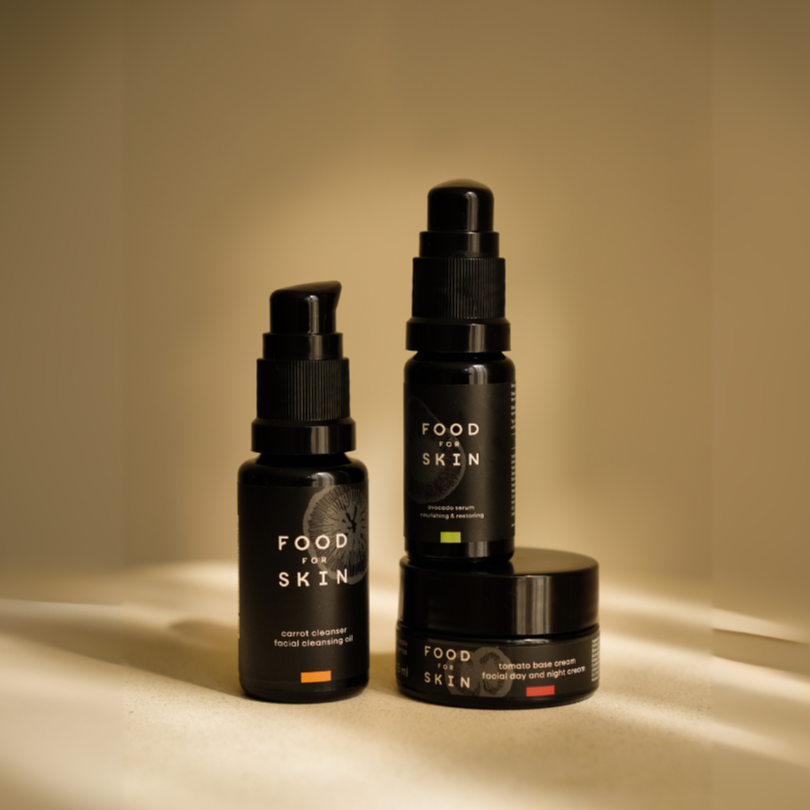
Protect your facial skin from weather influences with a non-aggressive, mild natural cream. The lycopene in Food for Skin's Tomato Base Cream protects you against free radicals. The avocado and broccoli seed oil restore the skin, make your skin soft, and protect it from external influences.
4. Use natural oil for dry skin
Be kind to your skin during these months and pamper it with a super mild oil cleansing based on carrot oil. Carrot oil stimulates your skin to produce collagen, nourishes your skin, and gives it a healthy complexion. You can even remove your eye makeup with it. Use the Carrot Cleanser on dry skin or delightfully in the shower. Wipe off with a warm, wet cloth and your skin is clean and nourished. For your body, we have a nice shower oil that provides extra care for your skin.
5. Give your dry face an extra boost in winter with a serum
During the day and at night, your skin can use something extra in these circumstances: a serum. A serum adds even more nutrients in combination with your cream, but can also be applied directly to your skin twice a week as a night mask. A serum gives your skin a real boost! At Food for Skin, you can choose from a Cucumber Serum for younger, sometimes impure skin, a Pumpkin Serum to prevent fine lines from no longer being fine, or an Avocado Serum to restore suppleness to your skin.
6. Cover your face when you are outside
If, despite extreme cold, you still feel like going outside for a walk or some ice skating, or it's necessary because you have to go to work, for example, cover your facial skin with a scarf and hat. Your skin can freeze!
What not to do if you have dry skin in winter:
1. Be careful with scrubbing.
If your skin is already sensitive, you can further damage your skin barrier with this.
2. Do not use cleansers with alcohol or perfume
This will dry out your skin even faster.
3. Vaseline/udder cream product, yes or no?
Opinions differ on the use of a Vaseline/udder cream product. It puts a nice oily layer over your face, protecting your skin from the outside, but it does nothing for your skin itself. It does not nourish your skin, so it gets too few nutrients and can dry out even further.
4. Take a good look at your favorite shower gel
In winter, it is best to use a product with an oil structure, so that your skin gets a thin layer of protection.
For dry skin, shower oil is often milder and more nourishing than a traditional shower gel. Moreover, you only need a small amount, as no water is added as a filler.
5. Do not set the heating too high without also paying attention to the humidity.
Heating is very drying, so ensure a good humidifier, possibly combined with an essential oil for a pleasant scent in your home.