What is waterless skincare?
2025-10-20 Angela Ursem
We love powerful, pure products that do what they promise. That's why we're a fan of waterless skincare. But what exactly is waterless skincare? And why would waterless skincare be more sustainable than skincare with water as an added ingredient? And what effect does it have on your skin? In this article we lay out everything about waterless skincare for you, so your choice of skincare products becomes even easier in the future.
In this article we answer the following questions:
-
What is waterless skincare?
-
Why did waterless skincare emerge?
-
The benefits of skincare without water
-
Downsides and things to consider
-
Who is waterless skincare suitable for?
-
Examples of products without water
-
Waterless skincare and sustainability
-
How do you choose the right waterless skincare?
Waterless skincare is a growing trend that we're seeing more and more in the cosmetics industry. But what actually is it? Simply put: skincare without added water. No aqua as the first ingredient on the label, but pure active ingredients such as oils, butters, or powders. Think concentrated balms, solid creams, pure serums, and powder masks. Also known as: water-free skincare, skincare without water, anhydrous skincare. Why this trend? Because it works. And because it's sustainable. That's exactly why we're such a fan!
You might not guess it, but most creams consist of up to 80-90% water.
It's worth noting that water is sometimes needed, to make a cream lighter or to bring hydrating substances into the skin. But, in many cases it's used as a cheap filler that does little for the skin. In that case more water is used than would be necessary, simply to bulk up the cream cheaply.
We work with two rich, cream-like products: the Tomato Base Cream and Rocket Eye Cream. And yes, if a liquid base is needed to make a cream, we don't choose water, but Aloe Vera or Tomato Juice. Although these juices are also watery, they also contain active ingredients, vitamins, and minerals that actually do something for your skin. So we don't go for the cheap water option, but for enriched 'waters' that nourish, protect, and strengthen. This way you get more than just hydration out of every drop.
Why did waterless skincare emerge?
1. The problem of water in cosmetics (80% of formulas = water)
Most creams consist largely of water. Unfortunately often a cheap filler that does little for your skin. And that while your skin actually needs nourishment, protection, and repair. Cosmetic products without water as a filler are richer in pure active ingredients and gentler on your skin!
2. Climate and sustainability: saving water in the beauty industry
Water availability is under pressure worldwide, while the beauty industry wastes millions of litres to be able to sell more jars of cream. Waterless skincare shows that this can be done differently, and even better. No unnecessary waste, but a well thought-out formula.
3. Clean beauty, eco-friendly, zero-waste
The conscious consumer really wants to make sustainable choices. Less clutter, less waste, more effect. Waterless fits seamlessly into that. It's a good solution for consumers who want to make more sustainable choices.
The benefits of skincare without water
1. Higher concentration of active ingredients
Skincare without water ensures that the active substances in the cream are more concentrated. No water = no dilution. Applying a facial cream without water is therefore much more effective than one with water as an added ingredient.
2. Better shelf life and fewer preservatives
In addition, water calls for preservatives. Creams without water need fewer preservatives, and in some cases none at all. That's better for sensitive skin.
3. Sustainability and environmental friendliness
We've of course already touched on the environment in the context of water consumption. But what about CO₂ emissions? Such a waste to transport packaging with such a high percentage of water, which does nothing for your skin! Pure, concentrated products also last longer. Ordering less often and less transport!
4. Ideal for travel
Another benefit of skincare without water? You need only a small amount of product, and probably fewer products overall. So a less full toiletry bag. Handy for travelling! You can easily take our Body Bars along in your hand luggage.
Downsides and things to consider with waterless skincare
Waterless sounds like the holy grail, but no product is perfect. And let's be honest: waterless skincare products have their own points to consider too.
Water makes products spreadable and light. Without water, a cream can feel richer or heavier than you're used to. That takes some getting used to if you've been used to a watery day cream for years. But you get intensive nourishment in return! For our Tomato Base Cream, we worked intensively with a professional laboratory for over two years. Together we searched for the perfect balance: a rich cream that nourishes and repairs at night, and a light, spreadable cream that absorbs quickly during the day and feels comfortable.
Waterless skincare can be stronger than you're used to, and sensitive skin sometimes needs to get used to so many active ingredients. The good news is that this often settles down after 2-3 weeks and your skin actually starts to glow more! Always test on a small patch of skin first if you know your skin reacts quickly.
Because the content of waterless cream contains more concentrated active ingredients than one with water as the main ingredient, the cost can be higher than you're used to. The advantage here, of course, is that you need less of it and are therefore likely to make it last longer.
Who is waterless skincare intended for?
Waterless skincare isn't a hype! It's a smart choice for anyone who takes their skin (and the planet) seriously. But who benefits most?
-
For dry skin
Do you have skin that always seems thirsty? That feels tight after showering and craves softness? Then waterless skincare is your new best friend. Because not a drop of water is involved, the formulas are rich in oils, butters, and active plant extracts. Not 'filler', but real nourishment. This way your skin stays supple, nourished, and protected, without having to keep re-applying. Do you already know our 100% natural elderberry shower oil?
-
For sensitive skin
Sensitive skin types often react to preservatives, fragrances, and other synthetic additives. In waterless formulas these are often not needed at all. No water means: less chance of bacterial growth, and therefore less need for synthetic preservation. That makes waterless skincare mild, pure, and often better tolerated for those who quickly become red, dry, or irritated.
-
For travellers and minimalists
Waterless skincare is concentrated, so you also need less of it and it lasts nicely long. Ideal for those who want to travel light with few products, but don't want to compromise on care.
Curious now? Here's some inspiration for skincare products without water:
Creams without water (day cream, facial cream, rich cream)
Balms are the flagship of waterless skincare. Think formulas with shea butter, jojoba oil, avocado oil, or plant-based waxes.
The Tomato Base Cream from Food for Skin is a facial cream without water, made from 100% natural ingredients. This day cream is also used as a night cream.
Other nice brands with waterless formula creams include: Muze Skincare and Abloom, which also work with 'enriched' waters. Loïs Lee doesn't work with creams but with an oil as day and night cream, without water.
Cleansing products (cleansing your face without water, balms)
In the field of facial cleansing there are more and more beautiful products that work without water.
Cleansing balms and oil cleansers melt away make-up and dirt effortlessly thanks to their rich oil texture. You apply them dry, gently massage in, and remove them with a warm, damp cloth. No foam, no tight feeling, but clean, supple skin.
Cleansing powders are also gaining ground: mix with a few drops of water to a soft paste. Perfect for sensitive or dry skin that doesn't like aggressive cleansers.
Our Carrot Cleanser is a natural, mild, and repairing cleansing oil without water. The oil cleanser cleanses thoroughly but also immediately leaves a protective layer behind. The cleanser doesn't foam and keeps your pH value intact.
You can find cleansing bars for your face without water at, for example:
-
La Rhode - cleansing balm/soap
-
Nature Bar - facial soap
-
Shampoo Bars - face bar
Powder and solid formulas (shampoo bars, masks)
From clay masks to enzymatic exfoliants: powder-form products are on the rise. They contain no water, stay fresh for a long time, and are lightweight. Add some water yourself and determine the perfect consistency, handy!
There are also the solid products, such as shampoo bars. Nice examples are the bars from Shampoo Bars, La Rhodé, and Nature Bar. They're compact, last long, and are ideal to take on trips. A plastic-free alternative to shampoo from a bottle, better for your hair and for the planet.
Waterless skincare and sustainability
The impact of waterless skincare on sustainability can be seen in several areas, from production to consumption.
Impact on CO₂ emissions and packaging
Waterless skincare products are more concentrated. That's positive for their consumption, since no unnecessary water is transported and you have to buy less often. It's also often the case that the product itself is smaller. That means: less packaging material, lighter transport, less CO₂ emissions. Add to that the fact that many brands opt for recyclable or refillable packaging. A total win-win!
Zero-waste beauty & circular cosmetics
Waterless fits perfectly within the zero-waste movement. No unnecessary filling, no wasted raw materials. This fits nicely alongside recyclable packaging or refill systems. What's more, you increasingly see formulas with upcycled ingredients such as by-products from the food industry. No waste, but real care.
Future of the beauty industry
The future is compact and effective. Waterless skincare shows that you don't need litres of water to achieve results. Beauty without unnecessary bulk, with maximum impact. Less waste, more efficiency.
The beauty industry has long run on empty promises, overconsumption, and lots of packaging waste. We hope that smart, high-quality formulas, short supply chains, and transparency become the standard.
How do you choose the right waterless skincare?
Does waterless skincare sound like something for you? Here's how to get started!
1. Check the INCI list
Does 'aqua' appear at the top? Then it's not a waterless product. You'll find tips for checking the rest of the ingredients in this blog.
2. Look at your skin type
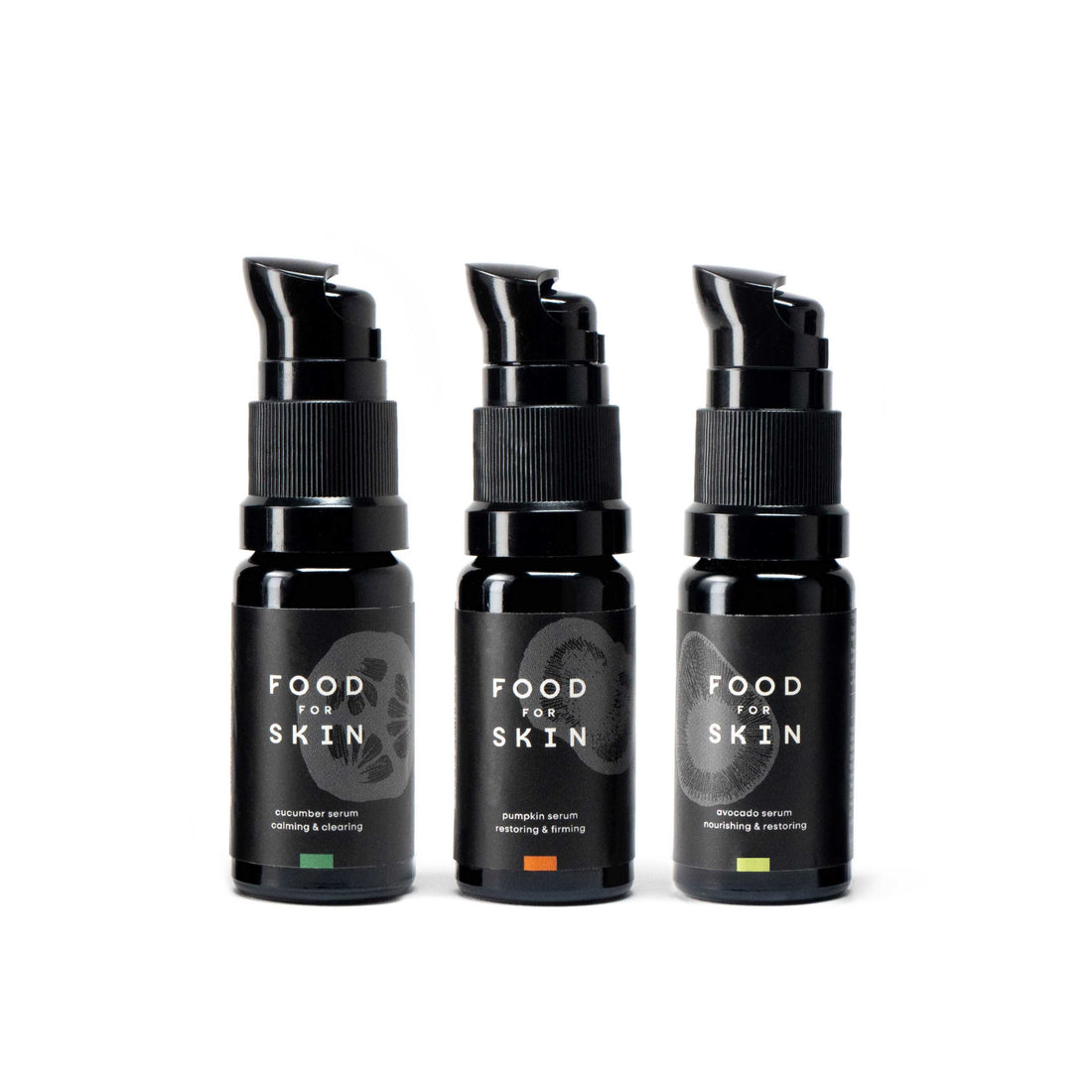
We prefer to talk about skin condition rather than skin type, because it's about the condition at that moment. That can vary! The more unsaturated fatty acids, the faster the oil absorbs into the skin. For dry and rough skin we recommend oil with lots of unsaturated fatty acids (Avocado Serum), and for oily skin we recommend the opposite (Cucumber Serum). Our Pumpkin Serum sits in between.
3. Integrate the products into your routine
It's super easy to replace your current routine of products with water as the main ingredient with a routine without water as a cheap filler. Better for your skin, better for your wallet!
Conclusion on waterless skincare
Waterless skincare isn't a hype, but a smart, conscious choice. For your skin and for the planet. No empty filler, no waste. Just pure ingredients that work.
At Food for Skin we believe in simplicity that works. In formulas that are honest and make a visible difference. Want to experience for yourself what waterless can mean for your skin? Dive into our collection and discover what really nourishes.