
The demand for natural skincare is growing rapidly. More and more people want to know what they are putting on their skin and are looking for products that feel more conscious, fairer, and better.
But while this need grows, the marketing of many brands often grows even faster. And that's exactly where the risk of greenwashing arises.
Greenwashing in skincare is the discrepancy between the marketing story and the actual content. In other words: between what a brand suggests and what is actually in the formula. Pretty words, green packaging with leaves, and reassuring claims don't always say anything about the true composition or effectiveness of a product.
In this blog, I'll explain what greenwashing in natural skincare is, why it occurs so often, and how you can learn to recognize it yourself. Because you really can. You don't need to be a chemist to learn to look more critically.
In short: greenwashing in natural skincare means that a product is presented as greener, more natural, or more sustainable than the formula or packaging actually is.
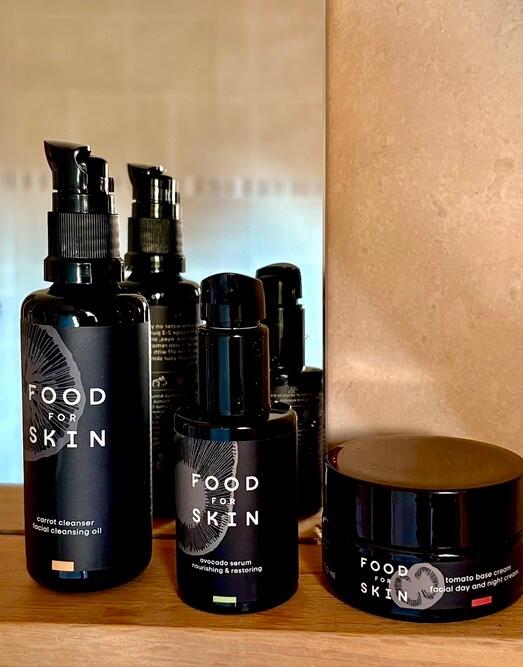
Food for Skin was partly created as a reaction to greenwashing. Because we ourselves were driven crazy by it and no longer knew what to believe. And despite our research, at some point, we couldn't see the forest for the trees.
And that's precisely why we believe that natural skincare should not be about cleverly chosen marketing and pretty words, but about clear explanations and honest formulas.
What is greenwashing in natural skincare?
Greenwashing in natural skincare means that a product is presented as more natural, greener, or more sustainable than the formula or packaging actually is.
Simply put: the claim doesn't align well with the content.
This usually isn't about a single isolated ingredient. It's about the whole. About the combination of packaging, language, claims, and composition.
A product can look very 'green' and yet have little to do with the natural image the brand promises. Greenwashing, therefore, revolves around claims that are not genuinely supported by what a formula and packaging contain or do.
Where things really go wrong
The problem usually isn't in one ingredient that you can pinpoint. It lies in the sum of
1. a story that sounds greener than the formula actually is.
2. terms and claims that inspire confidence without saying anything concrete.
3. marketing that seems clearer than the content itself.
Why greenwashing is so common in the beauty industry
The beauty industry is particularly susceptible to greenwashing because the image of a brand and its packaging is incredibly important on the cosmetics shelf. Most people don't just buy skincare for its function, but also for trust, feeling, and story.
Precisely because of this, words like 'clean', 'pure', 'free from', or 'natural' can have a big impact, even if they say little in terms of content.
Lack of clear regulations
A large part of the problem is that terms like 'natural', 'green', 'sustainable', or 'responsible' leave a lot of room for interpretation. For consumers, this makes comparison difficult. For brands, it makes it tempting to formulate things a little prettier than the content actually justifies.
Complex ingredient lists
Many people prefer to rely on a claim or slogans on packaging rather than an ingredient list. We completely understand that, because an INCI list (the ingredient list) is not easy to read. Yet, this list is often more honest than the front of a package. Those who learn to look more closely at ingredients automatically become less dependent on marketing language on the rest of a package. This is not easy, because those ingredient lists can sometimes be truly unreadable; you'd have to have studied chemistry for them ;-). Fortunately, there are various apps like 'inci beauty app' that can help you with this.
Marketing plays on insecurity
In the beauty industry, there's still a lot of focus on fear. Fear of 'chemicals'. Fear of 'synthetics'. Fear of complicated words. But complicated certainly doesn't automatically mean wrong. And natural doesn't automatically mean better.
As soon as a brand primarily sells on emotion or insecurity, without properly explaining what a product really does, that's a signal to look more critically. Is this really true? Do I agree with it?
Microplastics as an example of greenwashing in skincare
Microplastics are for me one of the clearest examples of greenwashing in skincare.
Why?
Because they often add little to nothing to the caring function of a product. They don't nourish your skin. They don't repair your skin. They are often used for texture, smoothness, film formation, or a luxurious feel. That doesn't automatically make a formula bad for your skin (though it is bad for nature!), but it does show how a green story can clash with the content. The tricky thing is that microplastics usually don't literally appear as microplastics on the packaging. So how are you supposed to know this? They are often hidden behind technical INCI names. As a result, many people don't recognize them.
They are often 'hidden' in sunscreen products. And then it might say on the front: with mineral factor. Which it then does contain, but often there is no mention of what else is in it.
And precisely there you see how greenwashing works: the marketing feels green, but the formula sometimes tells a different story.
Pay attention to this: if a brand strongly emphasizes naturalness, but the formula relies on synthetic texturizers that add nothing to the skin, then that is a reason to look more critically.
Common greenwashing claims explained
Many claims sound good but say little without context. Sometimes even nothing at all.
Clean beauty
Clean beauty has no fixed definition. It can mean something totally different for each brand. Without explanation, it's primarily a pleasant-sounding term, as if it contains nothing potentially harmful to you or nature. Unfortunately, it's not a protected term and there is certainly not one single definition. Every brand can put this on its packaging.
Dermatologically tested
This claim only states that a product has been tested under dermatological supervision. It says nothing about naturalness, sustainability, or the quality of the formula as a whole. Not even what the test results were. Only that it was tested.
Free from…
“Free from” claims often distract. Think of 'paraben-free', 'microplastic-free'. This hopefully holds true, but ultimately, what IS in it is more important than what is missing. A formula can be free of one known ingredient and at the same time contain other things you would rather not see in your products.
Naturally inspired
Naturally inspired is a creative formulation without any real hard guarantee. It doesn't state how many natural ingredients it contains, what role they play, or how the rest of the formula is constructed. It can also be a synthetic substance that is inspired by nature.
How to spot greenwashing from the ingredients?
Recognizing greenwashing starts by looking beyond the front of the package.
1. Compare the claim with the first ingredients on the back
The first 4 ingredients in an INCI list usually form the basis of the formula. It's often 60-70% of the formula (ingredients must be listed in descending order of quantity).
If a brand claims a product is very natural, but you see ingredients at the top that don't directly indicate that, then that's a reason to look more critically.
2. Pay attention to synthetic texturizers
Some ingredients are primarily used to make a product feel smoother, softer, or more luxurious. This is certainly not always wrong, but it becomes relevant when a brand positions itself very strongly on purity and naturalness. Check for microplastics with the 'plastic free future' app and check the origin with the 'inci beauty app'. Nowadays, this can be done very easily by taking a photo of the ingredient list on the website or packaging.
3. See if natural ingredients are actually functional
A plant extract on the front means little if it's at the bottom/one of the last on the ingredient list and thus barely contributes to the formula. The question is not just whether a natural ingredient is in it, but also what it does.
4. See if a brand explains why something is in it
Does a brand stick to pretty words and atmospheric images? Or do they really explain why an ingredient is in a product and what it adds?
The more explanation, the less likely marketing has to obscure the content.
Also read: How to read an INCI list for natural skincare
Why transparency is the only solution
Greenwashing cannot be solved with even more claims. The real solution lies in transparency. In explanation. In knowledge. But also in controlling greenwashing practices.
That's why I'm also happy that stricter rules will apply from autumn 2026 for green and sustainability claims towards consumers.
Too general claims will then be less easily used without proper substantiation. From then on, all words such as 'sustainable', 'responsible', 'green', 'better' must be substantiated with evidence and these claims must be made very specific.
You will no longer be allowed to say: 40% better. Because 40% better than what? You have to explicitly state what you have done. E.g. '40% less plastic in this tube than the last tube'.
That doesn't mean that greenwashing will suddenly disappear completely. That would be a utopia.
As long as these kinds of claims score well, some companies will continue to push the boundaries.
But it does mean that companies can be held more accountable. And that makes the playing field fairer for brands that are genuinely trying to avoid deception.
For me, that's the core: not aiming for perfection, but wanting to communicate more honestly, concretely, and carefully.
How Food for Skin deals with this
At Food for Skin, we try to be as clear as possible about what's in our products, why it's in there, and what it does for your skin. We believe more in explanation than in big promises. More in knowledge than in marketing language.
But I also find it important to be honest about this: we are not perfect either.
Sometimes we also say things too vaguely. Sometimes we simply don't have the exact data yet or not everything is as sharply substantiated as we would like. We are also continuously learning.
That's precisely why we find transparency so important. Not pretending that everything is perfectly in order, but always wanting to communicate more honestly, concretely, and better.
In short: greenwashing in natural skincare
Greenwashing in natural skincare means that a claim doesn't align with the content. The story then sounds greener, purer, or more natural than the formula truly is.
Therefore, the words on the front are not the guiding principle, but the ingredients and the product's overall function.
The good news is that you can learn to recognize this. You really don't need to be a chemist to ask better questions, use apps, look more critically, and be less quick to fall for attractive claims.
A little knowledge already helps tremendously. And that's exactly where honest skincare begins.