
The ingredient list is not something many people tend to look at quickly. Understandably so, because an INCI list feels technical, clinical, and inaccessible. Long Latin names. Synthetic-sounding terms. No idea where to start, right? We felt the same way!
Unfortunately, it is the place where you see what a product truly is. Not the label or advertising claims like 'natural' or 'clean'. But the back, where every ingredient must be listed honestly and in a fixed order.
What is an INCI list and why is it mandatory?
An INCI list is the official ingredient list of a cosmetic product. INCI stands for International Nomenclature of Cosmetic Ingredients. It is an international standard that is legally mandatory on every packaging of skincare products.
When we started Food for Skin, we wanted to display our ingredients as you would read a recipe with our recognizable, natural ingredients. We found out that this was not allowed and that it is mandatory to display the official INCI list. Where there is space, we try to add extra recognizable words in parentheses on the labels and boxes. And on our site, you will always find the INCI list written out in 'recognizable Dutch'. Because Solanum Lycopersicum (Tomato) Fruit Juice is 'just' tomato plant juice!
Is the INCI list the same as the ingredient list?
Yes. In cosmetics, the INCI list is simply the official ingredient list.
All ingredients must be listed completely and in a fixed order, from highest to lowest concentration. Nothing may be omitted.
Words like 'natural', 'pure', or 'free from' do not need to be substantiated here. The INCI list is therefore not an advertisement. It is the factual composition. This is precisely why it is the only place where you can objectively see what you are applying to your skin.
Where to find the INCI list on a product
The INCI list is often found on the packaging. You can often find it on the back of the bottle or tube.
Sometimes the ingredient list is not on the product itself but on the outer packaging, for example, on the box. If you throw that away, the information disappears too.
For smaller packages, where there is simply not enough space, the list may be on an insert. This is indicated by a small hand icon with a booklet.
Shopping online? Then the full INCI list must be mandatory in the product description. There too, you have a right to full transparency before you order anything.
Why the name 'ingredient list' is often confusing
Many consumers scan an ingredient list for recognizable words. If you see something familiar, it feels good. But INCI names are international and standardized. This means that every ingredient has the same name worldwide. Not the creative marketing term, but the official designation. And that's good, because it prevents brands from using their own fanciful names to make an ingredient sound prettier or more natural than it is. But as a consumer, it's not so easy to recognize what's actually written. You almost have to be a chemist to understand the list. But we're going to try to give you some pointers!
Why the order of ingredients is so important
On an INCI list, ingredients are always listed from highest to lowest concentration. What comes first is present in the highest amount. What comes last, the least.
It immediately tells you how a product is built. An easy one to recognize and pay attention to is water. If water is the first ingredient, then that is the base. If a vegetable oil is at the top, then that oil forms the core of the formula.
We believe in waterless skincare. Pure formulas with only ingredients that truly benefit your skin. For a cream, a water phase is needed for mixing. In many products, simply extra water is used for this. A cheap filler that adds nothing.
We do things differently. In our natural creams, we use tomato juice or aloe vera juice as a base. Yes, these naturally contain water, but also antioxidants, vitamins, and active substances that nourish and strengthen your skin. This way, the water phase truly serves a function for your skin.
What do the first ingredients say?
The first ingredients form the basis of the formula. They determine mass, texture, and the overall skin feel. But that doesn't mean everything that comes after is unimportant.
Some active ingredients are effective even in low concentrations. For safety or stability reasons, certain ingredients may not be formulated higher than 1 to 2 percent, as they could otherwise cause irritation. So a low percentage does not automatically indicate something about the efficacy or potency.
The first ingredients determine what the product is built upon, but active ingredients can be listed lower and still have a significant impact.
At the same time, it happens that an ingredient is added in a very low concentration mainly for marketing purposes. Think of an 'avocado shampoo' where avocado oil is at the very bottom of the ingredient list. In such a case, the ingredient probably plays no essential role in the product's effectiveness.
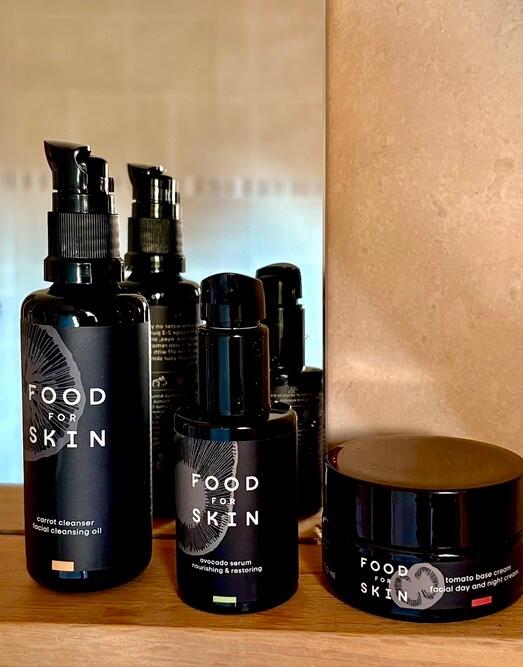
At Food for Skin, the products are named after ingredients that are either the main component or have an active functional role. For example, our Tomato Base Cream consists of no less than 88% tomato! Not a marketing trick, but an honest story.
Ingredients below 1%
All ingredients below 1% may be listed in any order. Therefore, the precise order at the end of the list matters less than the top. Pay extra attention to fragrances and allergens. Even in small amounts, they can be relevant to your skin.
How to recognize natural ingredients in an INCI list?
Reading an INCI list without aids like an app is not easy. However, you can learn to recognize patterns. The more often you look at ingredient lists, the more familiar the terms become.
Latin plant names as a point of recognition
Botanical ingredients are always listed with their official botanical, Latin name in an INCI list. This ensures consistent naming worldwide.
For example, if you see Helianthus Annuus Seed Oil or Aloe Barbadensis Leaf Juice, it means the ingredient comes from a plant. Extracts usually also carry the botanical name first, followed by "extract".
Names ending in seed oil, fruit extract, leaf juice or root extract refer to a specific plant part. These terms are standardized. A manufacturer may not simply label a completely synthetic substance as seed oil if it does not originate from a seed.
It is important to realize what this does not say. Such a designation does not automatically mean that the ingredient is unprocessed, organic, or cold-pressed. It only says something about its origin, not about its quality or degree of processing.
In addition, it is not a foolproof tactic because there are also synthetically replicated ingredients that are indistinguishable from natural ones by name.
In short: terms like Seed Oil or Leaf Juice indicate plant origin, but say nothing about how pure or minimally processed the ingredient is.
Oils, extracts, and ferments
Plant-based oils often form the basis of natural skincare. Many of these oils contain fatty acids similar to the lipids in our skin. Research shows that certain fatty acids can help support the skin barrier and reduce moisture loss.
Extracts deliver another layer of activity. They contain antioxidants and bioactive substances that can help protect the skin. The effectiveness depends on concentration and formulation.
Ferments are used because fermentation can convert substances into smaller or more available components. Some studies suggest that this can enhance biological activity. This aligns with the growing research into the skin microbiome and the role of microorganisms in skin balance.
This creates a formula that supports the skin based on existing processes, rather than completely taking them over.
Common misunderstandings when reading ingredients
Misunderstandings often arise from isolated information without context. Only one word or ingredient is considered and immediately labeled. Subsequently, an entire formula is declared good or bad.
However, an ingredient list does not work in black and white. It is about composition, concentration, and function within the whole. Without that context, you quickly draw conclusions that are incorrect. Learning to look calmly prevents this.
'Synthetic is always bad'
No! Not every synthetic substance is inherently problematic. There are many excellent synthetic ingredients that are safe, stable, and have a clear function in a formula. Think of preservation or improving stability.
The problem arises mainly with substances that have no skin function or are very aggressive for your skin. Think of many fragrances that can irritate the skin and, in the long run, can cause a skin allergy. Or strong stripping ingredients that deliver beautiful results in the short term, but make your skin dependent and weak in the long term.
It is also good to mention that everyone views things from a different perspective. Some platforms pay a lot of attention to perfume and fragrance, while others look at the quality of the ingredients. So, decide for yourself what you find important and focus on that.
If it sounds natural, it is natural
Unfortunately, no! "Natural" is not a protected term, unlike "organic". So the label can be green with pretty leaves and birds, but that says nothing about the contents. Only the INCI list shows what is actually inside.
Which ingredients require extra attention in natural skincare
In products with natural claims, you sometimes encounter ingredients that don't quite fit that narrative. This doesn't automatically mean they are bad or unsafe, but it does mean it's good to always look critically. Especially if you find it important that something is 100% natural and/or has less impact on the earth.
How we do it, you can read below.
For more in-depth information, read on: Skincare without microplastics
The Food for Skin way of evaluating an INCI list
We take a holistic approach. We don't focus on one ingredient that stands out and is convenient for marketing, but on the formula as a whole. A strong composition with only ingredients that truly have a function for your skin.
Although many ingredients are not forbidden, there are some groups that are regularly subject to discussion and therefore we prefer to avoid them.
Parabens
Methylparaben, butylparaben, ethylparaben, and propylparaben are synthetic preservatives. They are used to give products a longer shelf life. There has been debate around some variants regarding possible hormone-disrupting effects, as a result of which certain parabens have now been restricted or banned within the EU.
Sulfates
Such as Sodium Lauryl Sulphate (SLS) and Sodium Laureth Sulphate (SLES). These are cleansing foaming agents. They cleanse effectively, but can also have a drying or irritating effect on sensitive skin types.
Phthalates
Used as a solvent or to retain fragrance longer. Some phthalates are now banned in cosmetics in Europe due to potential health risks.
Mineral oils
Such as Paraffinum Liquidum or Mineral Oil. They form a sealing layer on the skin. This is not inherently harmful, but they do not actively nourish the skin as plant-based oils do.
PEGs and ethoxylated surfactants
Recognizable by names with PEG or -eth. These are used as emulsifiers or solvents. They are synthetically produced and do not fit within a completely natural philosophy.
Perfume / Fragrance
When it comes to perfume, it's important to know that "Parfum" or "Fragrance" on an INCI list is a collective term. It can be a composition of dozens of different fragrance substances and aromas. The exact composition does not have to be disclosed by the producer, as this is protected as a trade secret.
This means that with "Parfum" you cannot see which specific fragrance substances are in it, unless certain allergens exceed the legal threshold. These must be listed separately.
So with perfume, you have no idea what the exact composition is. That's why we consciously choose 0% perfume.
Synthetic dyes
Recognizable by CI numbers such as CI 26100 or F&D C colors. They have no skin function and are added for appearance.
INCI list reading for natural skincare in brief
An INCI list is a fact. Claims are marketing. The order shows what a formula is truly built upon. One ingredient says little without the entire formula.
So decide for yourself what you find important. A simple step is to start by paying attention to water (aqua) if you want a pure, waterless formula that will last you a long time. A second simple step is perfume (perfume, fragrance). After that, you can decide which other ingredients you want to avoid and learn to recognize. Fortunately, there are also many apps that can help you.