What is truly natural skin care?
2026-01-19 Angela Ursem
‘Natural’ – you see it everywhere... Green packaging with flowers and bees, advertisements set in forests, and grand claims and promises. The term is eagerly used, but what does it really mean?
For us, natural is not a marketing label, greenwashing, or a gimmick, but a way of doing things. We want to be honest, transparent, and clear with consumers, which is why we choose 100% natural ingredients. Because if something is 98% natural, what is that other 2%?
On this page, we delve into the meaning of natural skincare and where the nuances lie.
What natural skincare means according to experts
By natural skincare, we mean products with ingredients from nature: vegetables, fruits, seeds, kernels, plants, minerals, and without synthetic additives such as perfume, parabens, silicones, artificial fragrances and colorants, and microplastics.
It's about origin, processing, and skin effect. Unfortunately, there are no official rules for when something can be called natural. It's also good to know: natural does not necessarily mean mild and allergen-free. Many irritating substances can still be present in natural products.
Why the term ‘natural’ has become so unclear
In the beauty industry, ‘natural’ has become a catch-all term, plastered on anything that sells. Through clever marketing and vague claims, the term has been so often misused that it has lost its meaning and reliability.
From skin care to sales pitches
The demand for natural and organic cosmetics has grown explosively in recent years. And that's no coincidence. We are becoming more aware of what we put into our bodies and what we apply to them. Just like your body, your largest organ – your skin – also wants to be nourished with vitamins and minerals.
People are increasingly choosing products with honest, recognizable ingredients. No unnecessary additives, no complicated INCI list, but simply nourishing formulas that feel good and do good.
But where a trend emerges, brands eagerly jump on board. And unfortunately, not always with the right intention. Terms like ‘natural,’ ‘green,’ or ‘clean’ are thrown around, even if the product has little to do with it. The packaging looks like it's straight from the farm, but anyone who reads the ingredient list quickly sees: this is marketing, not a mission.
That's precisely why it's important to remain critical. To learn what to look for. And to choose brands that are transparent about what's in it and why. Because natural care should not only feel good; it should also truly be good. For you and for the planet.
Why ‘natural’ is not a protected term
What makes it extra difficult is that ‘natural’ is not a legally protected term. The term ‘natural’ is not legally defined. There is no official body that determines whether a product may bear this claim, as is the case, for example, with organic food.
Any brand can put it on the packaging, even if there's only one drop of plant extract next to a mountain of synthetic fillers. And that makes it unnecessarily complicated for you as a consumer. Because how do you know what's true, what works, and what just feels good for your skin?
Why is it not yet a protected term? We think the following.
-
Industry pressure. Large players in the beauty industry benefit from vague terms. They can easily capitalize on trends without truly changing their formulas. A strict definition of ‘natural’ would mean that many brands would have to reformulate their entire line.
-
Ingredient complexity. Many ingredients have both natural and synthetic variants, or fall somewhere in between (such as naturally derived). This makes a black-and-white definition difficult, and this is cleverly exploited.
-
Low priority for legislators. Cosmetics are less strictly regulated than food or medicine, especially when it comes to marketing claims. The focus is primarily on product safety, not terminology.
Why the beauty industry needs a reset
As a consumer, you practically need to be a chemist nowadays to navigate the endless claims, ingredient lists, and ‘green’ promises. Every jar proclaims something different. The market is overflowing, contradictory, and unnecessarily complicated. Instead of calm and clarity, skincare increasingly causes decision fatigue and overstimulation.
Over-care of skin and consumer
New trends follow each other at lightning speed. Today, retinol is your savior; tomorrow, you suddenly have to avoid everything with acids. And meanwhile, products continue to accumulate: for every skin area, every moment of the day, and every ‘problem,’ a solution has been devised. But the skin becomes unbalanced from all those changes and layers upon layers. Often, your skin needs less, not more.
Marketing over skin biology
The packaging gleams, the cream smells like a tropical cocktail, and it shimmers in the sunlight (great for Instagram!). But all that fuss often does little for your skin. On the contrary: fragrances and colorants are often the first triggers for irritation. It's time to cut through the glitter & glamour and go back to what counts: skincare that really does something for the skin. It mainly needs calm, a consistent routine, and ingredients that support rather than completely take over its function.
What is the difference between natural, naturally derived, and synthetic skincare?
It's important to understand the distinction between natural, naturally derived, and synthetic.
What do we mean by natural ingredients?
Natural ingredients are substances that come from nature (vegetables, fruits, seeds, kernels, plants) and are minimally processed. The original structure is maintained as much as possible. The end product thus remains close to its original form.
A good example of this is cold-pressed oil. This remains a natural ingredient, because although the oil is mechanically pressed from a plant or fruit, no heating or chemicals are involved.
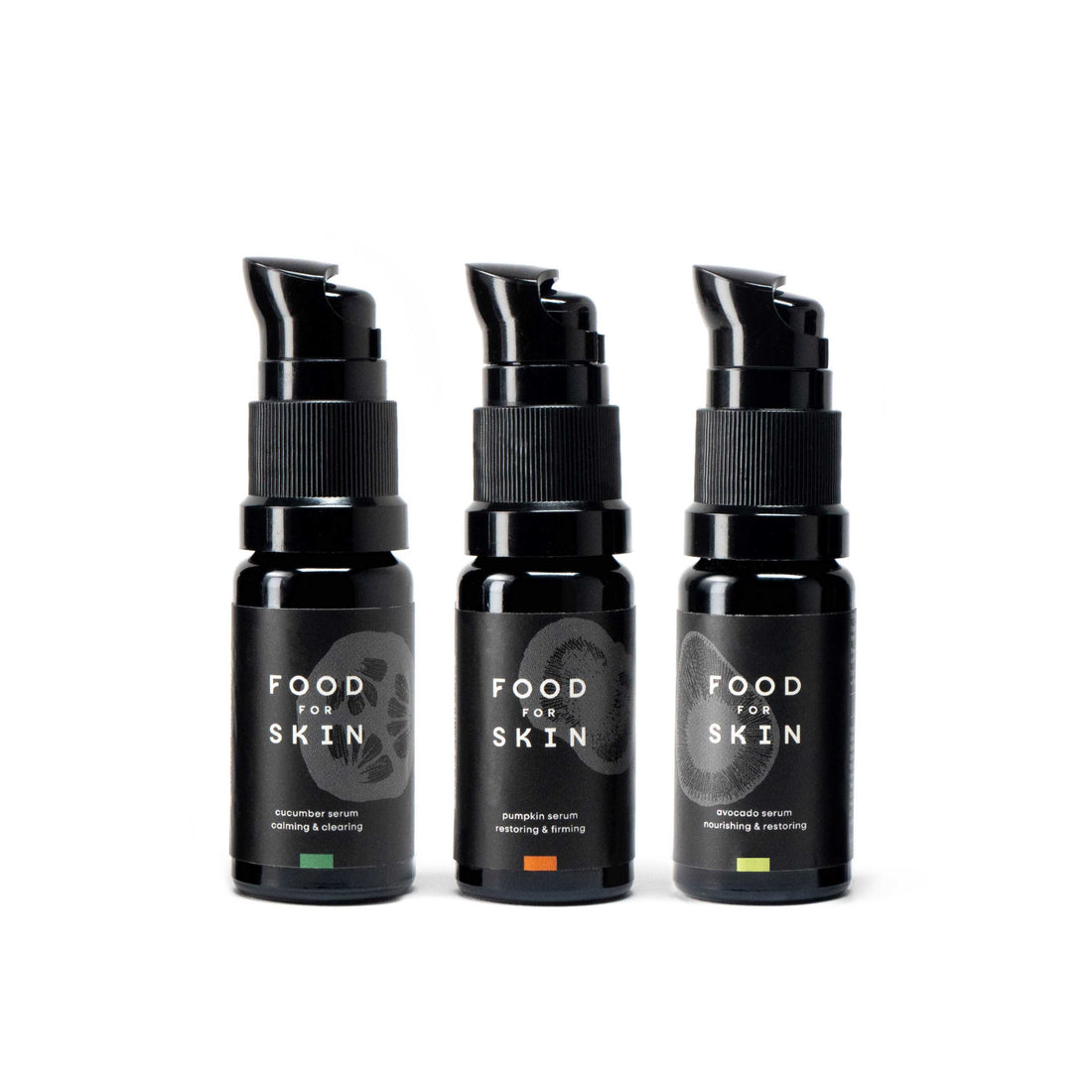
At Food for Skin, we therefore use cold-pressed oils as much as possible. This way, we stay close to nature and the oils are as pure as possible. In addition, valuable nutrients and bioactive substances are well preserved with the cold-pressed method.
What does naturally derived mean?
Naturally derived always starts with a raw material from nature, but is then processed. Many ingredients are processed to make them safe, stable, and effective for use on the skin. An extract is a good example of this: it is extracted from a plant, often through water extraction or by drying, whereby the active substances are concentrated.
We consciously choose the mildest possible processing methods, so that the original composition and efficacy of the plant are preserved as much as possible. Fewer interventions mean that what is naturally present remains intact and functional.
If a substance from nature is processed so extensively that its original structure can no longer be traced back to nature, it is considered synthetic. The boundary is not at a single fixed moment, but in the degree of processing: the more steps, the more artificial the process, the further an ingredient moves from naturally derived to synthetic.
Are synthetic ingredients always bad?
No. Synthetic does not necessarily mean harmful. Some substances are more stable in a synthetic form. The effectiveness of an ingredient depends more on how it is formulated and composed in the final product than on its natural or synthetic origin.
The problem arises when synthetic ingredients are added purely for texture, shelf life, or marketing value, without contributing anything substantial to the skin. There are also synthetic ingredients that may be hormone-disrupting or carcinogenic. Sometimes these are also substances that were allowed to be used for years and then banned.
Examples include:
-
Trimethylbenzoyl diphenylphosphine oxide (TPO) - a substance that makes gel hard in gel nail polish and other UV products. This will be banned in the EU from September 1, 2025, because it is classified as potentially harmful to reproduction (CMR).
-
Lilial - a widely used synthetic fragrance that has been banned in cosmetics in the EU since March 2022 due to concerns about reproduction.
-
The Three Os Octocrylene, Oxybenzone and Octinoxate UV filters in sunscreen are increasingly under fire for potential endocrine-disrupting effects, skin irritation, and environmental damage, particularly to coral reefs.
-
Endocrine-disrupting effects (especially oxybenzone and octinoxate)
In addition to potential skin problems, there is also a problem for the earth and nature. Synthetic substances such as microplastics (also called forever plastics) disappear down shower drains and pollute the earth.
When is skincare no longer natural?
For us, the definition is clear: a natural product should only contain natural and naturally derived ingredients. As mentioned, we therefore opt for 100% natural, so you can be sure that there is no small percentage of unnecessary silicones, microplastics, and excessive fragrances.
There are various apps and websites that help you scan ingredients so you can make a choice based on what is important to you.
How does Food for Skin view natural skincare?
At Food for Skin, everything starts with the skin itself. How does your skin barrier work and how do you ensure that you support it and don't completely take over its function?
Skin biology as a starting point
Your skin is your largest organ and a living mechanism. On your skin lies a natural layer (the microbiome), invisible to the eye, where natural oils, viruses, and bacteria live to ensure your natural ecosystem functions. If you treat this skin barrier with aggressive, drying ingredients, you can endanger, destroy, or shut down this delicate ecosystem. This results in an unbalanced, sensitive skin barrier with skin problems. That's why we believe in supporting it with natural ingredients.
Why we work with plant-based ingredients
Those who have followed us for a while know this: at Food for Skin, we don't fall for ingredients that suddenly go ‘viral’ on TikTok. We thoroughly investigate what truly works. Sometimes trending ingredients are deservedly popular, but often they are used as a marketing tool.
We work with plant-based ingredients because their active compounds, long history of use, and scientific basis align with a functional approach to skincare. Not because it's a trend, but because it works.
Nowadays, whole natural ingredients are often dissected into peptides and amino acids. Niacinamide is one of those trending ingredients. But did you know that Niacinamide (B3) is naturally present in chia or rice bran oil? Peptides are small chains of amino acids that can support your skin – they're also a hype. Instead of adding them synthetically, we use oils like sunflower, pumpkin, and wheat germ oil, where they are naturally found.
Cosmetic giants are constantly looking for innovation because that sells. “Sunflower oil” might not sound as sexy as “high-tech peptide complex,” and so, in no time, shelves are filled with new creams. It's also trendy now to promote Vitamin C as a separate ingredient, but most fruits and vegetables already contain it.
We don't participate in that. We prefer to use pure oils that naturally contain vitamins, minerals, and antioxidants.
We also do not choose fillers: no water or microplastics as cheap fillers. All ingredients are included with a function. Read more about the benefits of waterless skincare here.
Conclusion: what natural skincare truly means
Natural skincare is not about a green label with empty terms, but about efficacy, origin, and honesty. At Food for Skin, we believe in simplicity, transparency, and ingredients that truly make a difference. Not because it says so on the packaging, but because it works. Choose consciously, read further, and discover how to recognize and apply natural skincare, tailored to your skin type.