Skincare by age; this is how you do it
2023-05-19 Angela Ursem
We often get questions like 'what skincare do I need'? And also questions about whether a son or daughter can use Food for Skin products too, because they want to use natural products, without junk. Below you'll find a good skincare routine for every age.
Skincare by age
Skin protection in general is always important, starting from baby skin. Food for Skin doesn't have products for babies or children (except for sun protection!). So here are some general tips.
Tip 1
It's important to choose products that really nourish a child's skin barrier when needed, and protect it. In any case, we recommend paying attention to microplastic-free products, without strange ingredients, and as natural as possible, so you understand what you're applying.
Tip 2
Make sure you pay close attention to what your child needs, and always visit an expert for real problems.
Tip 3
Don't apply too much, but make sure the microbiome (the skin flora) is healthy and strong by caring for the skin during or after a bath with a nourishing and protective cream or oil specially suited for children.
Tip 4
Avoid using foaming soaps as much as possible, as they dry out the skin. Water also dries the skin out, which is why we recommend applying cream after bathing.
Tip 5
Of course, good sun protection is important for your child, and above all, never directly in bright sunlight! Young skin has rapid cell division, which is what makes the skin feel firm and supple. That's where the term 'baby skin' comes from.
Skincare at 12, 13, 14, 15 years
Puberty! How do you approach facial care for young skin? And from what age do you start using a day cream? Hormone fluctuations at their peak, which for many people can often be seen in the skin too. From personal experience, we know how difficult this is and how desperately you search for that miracle cure and want to believe every advertisement. Many of the products specifically marketed for acne are very aggressive. The products are often extremely drying, which may dry out the pimple, but puts the rest of the skin under great stress. Dehydration causes the skin to produce even more sebum, and if your skin produces too much sebum, you get clogged pores, which leads to... pimples! A vicious circle, in other words. You'll also often see that these products seem to help temporarily, but as soon as you stop: bam, everything is back. Your skin becomes 'addicted' to the products, stops regulating itself, and becomes dependent. That's why our approach is different. Don't fight pimples with aggressive products, but nourish the microbiome in a way that restores balance in the skin barrier. That said, with severe acne you should always seek help from, for example, a skin therapist who specializes in this. Your GP can also prescribe products, but keep in mind that these types of products often disrupt the skin flora. You might end up with no more pimples, but flaky skin instead. That's not necessary, it can be done differently, so seek specialized help in that case. Food for Skin's products weren't originally designed specifically for teenage skin (also not considering the pricing and packaging), but from experience we now know that they can work really well for the teenage years up to about 20.
The best skincare routine from 20 to 40 years
Your teenage hormones stabilize around age 20, and then a new 'skin phase' begins. At this age, it's important to keep the skin barrier nicely balanced and well cared for, so your skin stays in the best possible condition.
From what age should you start anti-aging?
"Should you already start using anti-aging products when you're young?" we're often asked. As you may already know, we prefer not to use this term. Because getting older is a fact, and your skin changes too. Embrace it! That doesn't mean you can't take the best possible care of your skin. We just don't want to contribute to 'beauty culture', where you feel pushed to do a lot to your skin and end up unhappy because you can't live up to the picture-perfect image on Instagram. We do believe that good maintenance does you good, just like with a car. If you maintain your car regularly, the damage is less severe. It works exactly the same way with your skin. So from this age on, it's really important to cleanse your skin daily, but especially to protect it! Because a lot is released onto your skin from the outside: acid rain, wind, sun, free radicals.
For the ages 20-40, we recommend this as a skincare routine:
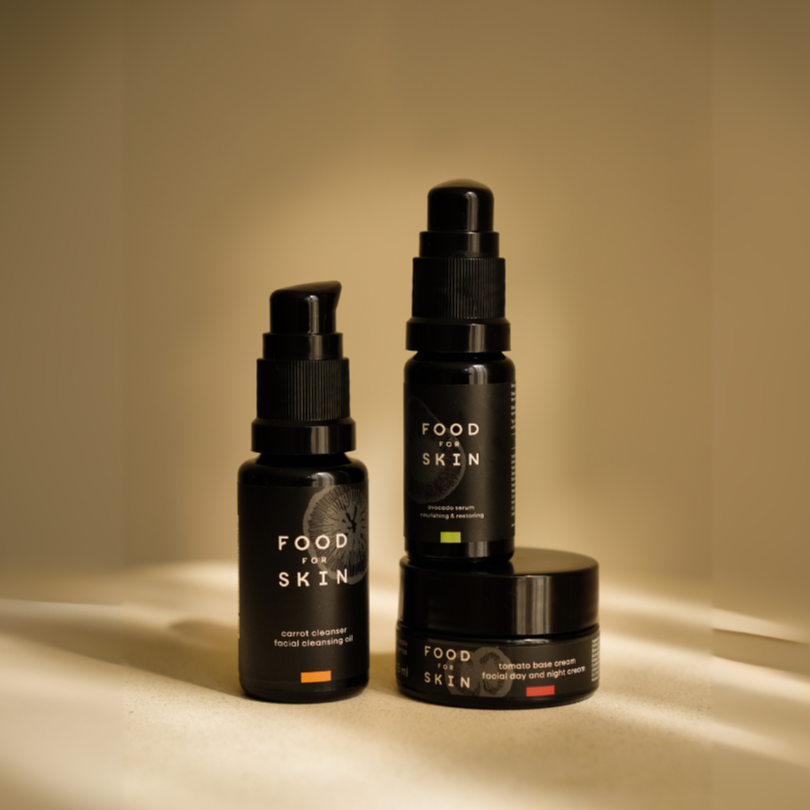
1. Cleanse gently with the Carrot Cleanser on a wet face. Gently wipe in a circular motion with a washcloth to softly remove dead skin cells. Don't scrub!
2. Apply a little Cucumber Serum in the morning and evening. Cucumber seed oil is a great ingredient for keeping the skin supple and firm. It regenerates the skin and thereby stimulates cell renewal.
3. Protect the skin both in the morning and in the evening with the Tomato Base Cream day and night cream, which, among other things, works perfectly against airborne pollution.
Extra:
Twice a week, you can pamper your skin a little extra by applying the Cucumber Serum a bit thicker at night on clean skin as a night mask. All our serums are free of essential oils, so they can also be used around the eye area. Because of the oil structure, eye makeup can run if you apply it right beforehand. Keep this in mind.
If you notice, for example after summer, that you have more trouble with dead skin cells, use the Apple Peeling. This is a super mild peel that dissolves dead skin cells through an enzymatic action.
A special night cream isn't necessary if your cream doesn't contain SPF. So you can also happily use the Tomato Base Cream at night, on a clean face.
Use at least SPF30 on sunny days.
The best skincare routine for ages 40 to 55
Especially for women, but also for men, you'll notice that your skin feels different. Just like with teenagers, this is due to changes in hormone levels, and for women the transition, menopause. You see that reflected directly in your skin. You may suddenly experience couperosis (red veins), pigment spots, redness in the face, or even pimples again. Your skin can also become a bit drier, weaker and looser because the collagen in your skin decreases. That's simply part of it, but it is good to adjust your skincare accordingly. You do this by, among other things, adding fats to your skincare routine and letting the skin retain moisture as well as possible. There are products on the market that (temporarily) smooth out wrinkles (blurring), but Food for Skin doesn't have those products, because we go for 'real' and 'natural'. But if it really bothers you, you can certainly consider it (then do choose a natural variant!). Also pay attention to your make-up use: mattifying products tend to make the skin look drier and older. Make-up with a bit of shine makes your face look livelier. Do you suffer from pigment spots? In any case, it's really important to protect your skin well against the sun with at least factor 30, not to scrub, exfoliate excessively, or treat your skin with a peeling lotion (e.g. BHA or glycolic acid) before going into the sun. This removes the skin's natural protective layer, which can accelerate pigment disturbances in the sun. With pigment spots, it's important to use a Vitamin C product. The Food for Skin Pumpkin Serum contains lots of vitamin A, B2, and C! Cleanse your skin with a mild product, such as the Carrot Cleanser.
A good skincare routine from age 55
From around age 55 as well (of course, for some a bit earlier and for others later), hormonal changes also play an important role for the skin, really just like in puberty.
The skin becomes a lot less elastic and firm. If you want to prevent this, it's really important to start good maintenance for your skin in good time. And that's not just in your skincare, but of course it's also massively influenced by alcohol, smoking, stress, your diet, medication use, etc.
Serum for mature skin
Since the skin will become a bit drier as you get older, we recommend oil-based serums. The Food for Skin Avocado Serum is a great example of this. The vitamins, minerals, and essential fatty acids nourish dry skin and make it supple again.
Your skin becomes less able to keep the microbiome well balanced, so use a cleansing oil or milk, and avoid soapy or foaming products. These only dry the skin out further. The Carrot Cleanser is a super mild and nourishing cleanser and leaves the PH value alone. So you no longer need to use a toner or tonic afterwards, because the skin's PH value isn't affected.
Protect your skin against weather influences and air pollution with the Tomato Base Cream day and night cream, and pamper your skin at least once a week with a rich oil-based mask. A thicker layer of Avocado Serum at night also works wonders.
The skin around the eyes is basically exactly the same skin as the rest of your face, but thinner. That's why fine lines stand out sooner there. A small amount of serum around the eye softens the skin. If you don't like using an oil-like substance, we have the Rocket Eye Cream especially for you. It tightens the skin around the eyes, making it look softer.
The above are tips per age, for men and women, but besides these there are of course also many general tips:
- Call in a skin therapist if you have real problems.
- Always protect your skin from the sun.
- Make sure you have a healthy diet, drink plenty of water, and maintain good humidity at home.
- Alcohol really does affect your skin, so use it sparingly.