Common mistakes in natural skin care
2026-01-16 Angela Ursem
Trying to do too much at once, expecting too much, and taking too little time are common mistakes with natural skin care.
Sound familiar? You see an influencer's enthusiastic post... after much hesitation, you buy it, and the first time you use it, you think, "Oh no, will this even work for me?"
So how do you know if natural skincare is right for you? Based on experience and thousands of reviews, we can conclude: you can achieve great results with natural skincare, but it's not a quick fix!
The most common mistake when switching to natural skincare is expecting overnight results. You only see real results after three or four weeks, once your skin has adjusted and regenerated! And yes, that can mean your skin needs to adjust to menopause, sometimes feeling a bit unsettled in week two.
The most common mistakes are:
-
Changing too much at once
-
Of course, not to be confused with 'always mild'
-
Combining ingredients without logic
-
Unrealistic expectations
-
Focus on marketing claims instead of skin knowledge
Changing too much at once
A common mistake when switching to natural skincare is changing too much at once, making it difficult to tell which changes are having which effect. The skin doesn't have time to respond to that single change and becomes confused. This applies to both synthetic and natural products.
If you switch to a single, complete line from a single brand, you can assume the products will complement each other well. But in practice, you often end up with a variety of products from different brands. This can work well together, but it's something you'll need to experiment with.
Our tip is that if you are going to change things in your routine, do it product by product, or switch to a completely different line in one go.
Confusing 'natural' with 'always mild'
Natural ingredients are gentle on the planet (because they're biodegradable), but that doesn't automatically mean they're always gentle on the skin. Depending on the type of product and the desired result, it may also contain natural ingredients that aren't gentle and shouldn't be.
A natural peel, for example, isn't necessarily gentle, as it removes dead skin cells. But in this case, that's precisely the point. The enzymes and acids in a peel dissolve those dead skin cells. It's not a gentle treatment, but one you do occasionally when your skin is feeling a bit duller, after a long summer, or after a period of heating.
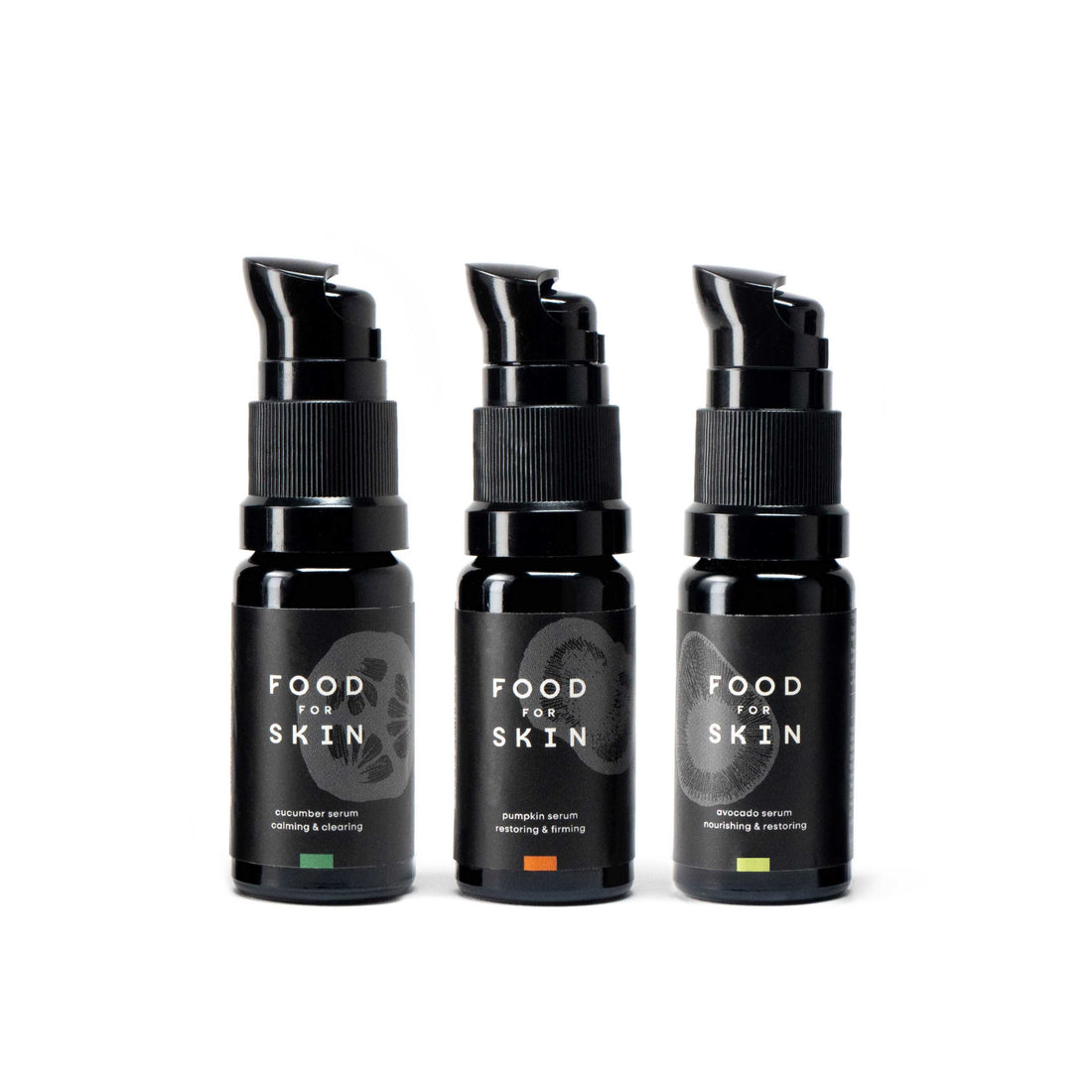
Essential oils are natural, but they can potentially trigger an allergic reaction if you're sensitive to them, especially if added in large doses. Food for Skin uses essential oil in two products ( Tomato Base Cream and Carrot Cleanser ), but in very small amounts. The oils also have an added benefit: they leave you feeling fresh and energetic. However, if you have an allergy to certain fragrances or hypersensitive skin, we recommend avoiding products containing essential oils, just to be safe.
So, pay close attention to the ingredients of both natural and synthetic skincare products. A handy app is the INCI Beauty App. It provides a score that tells you whether ingredients are potentially irritating or not, why they're in the product, and who might be sensitive to them.
Combining ingredients without logic
The advantage of choosing all your products from a single line is that they complement each other. If you mix different brands, you might unknowingly end up with too much of a particular substance on your skin. Too much of certain substances can also cause your skin to react. This applies to both synthetic and natural skincare.
A practical mini step-by-step plan:
• Week 1 to 2, change cleanser only or cream only
• Week 3 add second step
• When to pause and when to persevere
• Patch testing on your elbow is always recommended for sensitive skin
Contact a doctor in case of a severe reaction!
Overstimulating your skin with too many products and too many actives (active ingredients that have a highly targeted effect on the skin) is never a good idea. Less is better for your skin. Give your skin a break, let it work independently, and only support it when needed. Listen to your skin!
Confusing marketing with skin knowledge
Advertisements, social media posts, and websites all make all sorts of claims and promises about skin. Be aware that these are generally marketing claims trying to persuade you. Marketing claims are often made with the sharpest of judgments, just barely within legal limits. For example, did you know that you can say "for healthy-looking skin," but not "to make your skin healthy"? The latter would be a medical claim, which isn't allowed, but the first sentence creates the illusion that it will make your skin healthy again.
Claims are often made about individual ingredients, not the total total. For example: 91% skin improvement when using ingredient XYZ. While you can say that, considering the overall composition of the product, it doesn't really mean much, as it depends on the percentage of that ingredient in the final product.
Marketing claims can therefore raise expectations that cannot be met in practice.
What we believe is important is that you pay attention to and listen to your skin, and listen less to all sorts of well-intentioned advice. What does your skin need, how does it feel, what do you crave? Find products that match your needs and don't just use something "because everyone else does." Check the ingredients, read the reviews, and scan the products with an app like the Inci Beauty App to understand if they're the right ingredients for you.
When natural skin care actually works
But how do you know if natural skincare works for you? There are great natural and synthetic ingredients, and less great natural and synthetic ingredients. Use tools like an app to understand what's in them and whether your skin needs it.
If you're looking for skincare that's good for you and the environment, natural skincare is probably the better choice, because these substances are generally biodegradable. So, no microplastics or other toxins end up in nature down the drain.
Natural skincare works well if you take the time, if you manage to give your skin a rest, and if you can balance it with caring for your body and mind. Skincare isn't magic, but it does support your natural barrier where needed. And that's how it should be!
This is how we test ingredients
At Food for Skin, we choose ingredients not because they're trendy, but because they demonstrably contribute to healthy skin and a healthy planet.
We test each ingredient against fixed criteria:
1. Skin barrier first
We assess whether an ingredient supports or could disrupt the skin barrier. We eliminate anything that unnecessarily irritates or disrupts the balance, especially for sensitive or reactive skin.
2. Functionality over marketing
An ingredient must have a clear function in the formula. Hydration, repair, protection, or soothing. Not for the story, but for the effect.
3. Concentration and composition
Even a good ingredient can be unsuitable in too high a dosage. We always consider the combination of ingredients and the overall skin irritation load.
4. Naturally where it works
We consciously choose natural ingredients that are proven effective and gentle. For us, natural isn't a goal in itself, but a conscious choice within a well-thought-out formula.
5. Transparency and provenance
We verify the origin, processing method, and environmental impact. No microplastics, no unnecessary synthetic additives, and as much biodegradable as possible.
6. Suitable for daily use
Our products are designed for long-term, daily use. This means they are gentle, stable, and supportive of your skin over the long term.
This is how we create skincare that is not about promises, but about trust, simplicity and results.
Common skincare mistakes in brief
Natural skincare can deliver beautiful results, but take it slow. The biggest pitfall is trying too much at once, with unrealistic expectations of quick results. Your skin needs time to adjust and regenerate; you often only see real results after three to four weeks, and your skin can become a bit restless in between. Mistakes arise from trying everything at once, confusing "natural" with "always gentle," and prioritizing marketing claims over skin knowledge. Fewer products, gradually building up your routine, listening to your skin, and focusing on ingredients instead of promises: that's how natural skincare works as intended.