
Congratulations, you're pregnant! Pregnancy is a special time when many changes occur in your body. You often notice this in your skin too. Where your skin was once calm and balanced, it can suddenly become drier, more sensitive, or even more troubled during pregnancy.
Many women therefore wonder how best to adapt their skincare during pregnancy. Can you continue to use your normal products, or are there ingredients you should be careful with?
The good news is that you can usually continue to care for your skin as usual. With mild skincare and a simple routine, you can support your skin without over-stressing it. In this guide, you will learn more about skincare and facial care during pregnancy, which ingredients are often considered mild, and which many people prefer to be more cautious with.
Why does your skin change during pregnancy?
During pregnancy, your body produces extra hormones. These hormonal changes can affect the skin. Some women notice that their skin becomes more sensitive, while others experience increased sebum production or are more prone to pimples.
Pigmentation spots are also more common during this period. This is often called the mask of pregnancy or melasma. At the same time, there are also women who notice that their skin glows more than usual.
Because every skin reacts differently, it can be pleasant to choose mild skincare that supports the skin barrier during this period. At Food for Skin, we believe that skincare should primarily work with the skin. Products do not need to correct the skin, but should help it stay in balance.
Facial care during pregnancy
Facial care during pregnancy usually doesn't have to be complicated. Many people find that a calm routine works well when the skin becomes more sensitive.
A mild cleanse helps remove dirt and makeup without disrupting the skin barrier. Afterwards, a hydrating product can keep the skin supple and support its natural balance. Some people also opt for a serum with antioxidants to provide extra care for the skin.
Sun protection also plays an important role in your skincare routine during pregnancy. Hormonal changes can lead to quicker formation of pigmentation spots, making protection against UV radiation extra important.
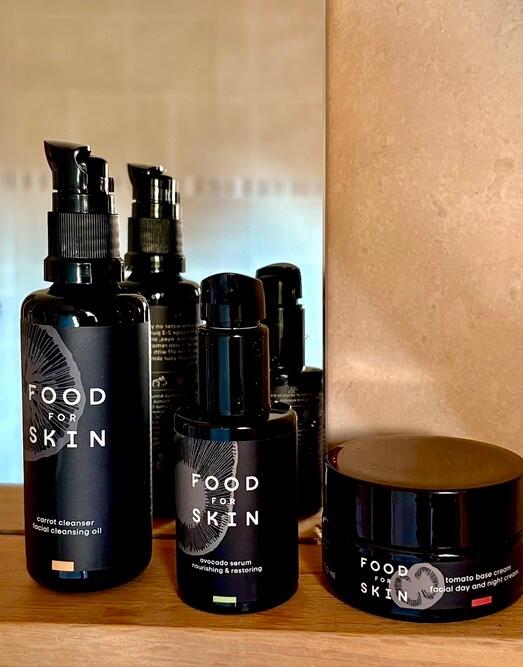
For a mild basic routine, you could, for example, choose a gentle cleanser, a nourishing oil or cream, and daily sun protection such as our SPF 30 with zinc oxide.
What to avoid in your facial care
During pregnancy, it can be pleasant to be more conscious about what you apply to your skin. After all, the skin is our largest organ and certain substances can be absorbed into the body to a limited extent through the skin. Therefore, many people choose to keep their skincare routine simpler and milder during this period.
One ingredient that is often mentioned is retinoic acid, also known as retinol. Vitamin A is an important nutrient during pregnancy, but a too high intake can be undesirable. This applies, for example, to liver products or supplements with a high dosage of vitamin A. Therefore, it is often advised to choose supplements with beta-carotene during pregnancy and to be cautious with products containing retinol.
Fruit acids such as glycolic acid and lactic acid are also regularly found in skincare. In low concentrations, these ingredients are often used to refine skin texture. At concentrations above ten percent, these acids can make the skin more sensitive, especially when hormonal changes already make the skin more reactive. Many people therefore choose milder formulas during pregnancy.
Our Apple Peeling, for example, contains five percent vegetable fruit acids derived from lemon and grape. Due to this low concentration, the product is generally considered mild. We do recommend not using it on damaged skin and always consulting a doctor if in doubt.
Another ingredient that often raises questions is salicylic acid. This ingredient belongs to the BHA acids and is often used in products for impure skin. In skincare products, the concentration is usually around two percent. Although this is generally considered a low concentration, some people choose to avoid products with salicylic acid during pregnancy.
Not every brand states the exact amount of the ingredient. When the concentration is unclear, it can be reassuring to temporarily choose an alternative.
Would you like to read more about this? In our blog salicylic acid during pregnancy we explain in more detail how this ingredient is used in skincare.
Within our products, we deliberately do not use BHA acids. These can penetrate deeper into the skin, while AHA acids mainly work on the skin surface.
Fortunately, there are many natural ingredients that can gently care for the skin. Vegetable oils such as avocado, almond, and apricot kernel oil help keep the skin supple and support the skin barrier. Antioxidants from, for example, tomato, avocado, or seaweed are also often used to protect the skin from external influences.
What is allowed: mild skincare during pregnancy
At Food for Skin, we believe in simple skincare that supports the skin's natural functions. When the skin barrier is in balance, the skin can better protect and repair itself. Ingredients often considered mild include:
-
Lactic acid (AHA)
-
Glycolic acid in mild concentrations
-
Vitamin C
Additionally, hydrating ingredients like aloe vera and cucumber extract can help soothe the skin when it feels more sensitive. Vegetable oils such as avocado, almond, and jojoba oil support the skin barrier and help keep the skin supple.
During pregnancy, the skin can also react more sensitively to sunlight. Hormonal changes can lead to faster formation of pigmentation spots. Therefore, it is often advised to use daily sun protection.
A broad-spectrum SPF protects against both UVA and UVB radiation, and an SPF 30 or higher is often recommended for daily use. Mineral sunscreens with zinc oxide are a popular choice during pregnancy, as they remain on the skin and reflect sunlight. Our SPF 30 with zinc oxide is therefore also suitable for use during pregnancy.
Many people also choose to avoid ingredients that can dry out or irritate the skin. Ingredients often avoided include:
-
Salicylic acid (BHA)
-
Retinoic acid (retinol)
-
Fragrance as an ingredient
-
Alcohol as an ingredient
-
Sodium Lauryl Sulfate (SLS)
-
Sodium Laureth Sulfate (SLES)
-
Oxybenzone
By choosing pH-friendly formulas, the skin barrier remains better balanced.
Food for Skin products are developed with this philosophy in mind. They are 100% natural, vegan, and locally produced, without unnecessary additives. This way, you can care for your skin gently, even during pregnancy.
Checking ingredients yourself
Do you want to check which ingredients are in your skincare yourself? You can always check a product's ingredient list. This official ingredient list is also called the INCI list. The INCI list states all ingredients in order of concentration, from highest to lowest.
In our blog How to read an INCI list for natural skincare? we explain step by step how to understand such a list and what to look for when choosing skincare.
Conclusion: skincare during pregnancy
During pregnancy, your skin deserves extra attention and gentleness. Hormonal changes can make your skin more sensitive, drier, or more unpredictable - and that's completely normal. With the right natural skincare during pregnancy, you give your skin exactly what it needs: mildness, hydration, and protection, without unnecessary or potentially harmful ingredients.
At Food for Skin, we believe in the power of nature and conscious choices. Our products are natural, safe, and developed with great love and care. For you, your skin, and the planet.
💚 Discover our trial set and experience how good natural skincare feels, even during your pregnancy.